Motive


This blog was set up as a personal project to record my study notes online. The large majority of the writings are those of the authors mentioned in the posts.

Wednesday, August 21, 2019

Deductive reasoning

Wikipedia:

Deductive reasoning, also deductive logic, is the process of reasoning from one or more statements (premises) to reach a logically certain conclusion.

Deductive reasoning goes in the same direction as that of the conditionals, and links premises with conclusions. If all premises are true, the terms are clear, and the rules of deductive logic are followed, then the conclusion reached is necessarily true.

Deductive reasoning are general to specific while inductive reasoning are specific to general.

Deductive reasoning ("top-down logic") contrasts with inductive reasoning ("bottom-up logic") in the following way; in deductive reasoning, a conclusion is reached reductively by applying general rules which hold over the entirety of a closed domain of discourse, narrowing the range under consideration until only the conclusion(s) is left.

Facts > FACTS

In inductive reasoning, the conclusion is reached by generalizing or extrapolating from specific cases to general rules, i.e., there is epistemic uncertainty. However, the inductive reasoning mentioned here is not the same as induction used in mathematical proofs – mathematical induction is actually a form of deductive reasoning.

Trend > Generalizing

Deductive reasoning differs from abductive reasoning by the direction of the reasoning relative to the conditionals. Deductive reasoning goes in the same direction as that of the conditionals, whereas abductive reasoning goes in the opposite direction to that of the conditionals.

 

Statistics - Pearson product-moment correlation coefficient

 From Laerd Statistics

What values can the Pearson correlation coefficient take?

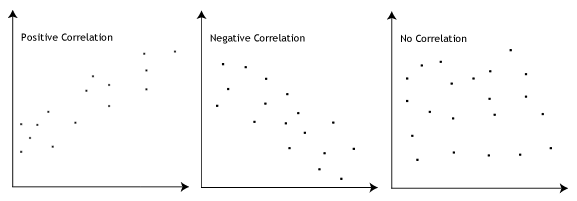
The Pearson correlation coefficient, r, can take a range of values from +1 to -1. A value of 0 indicates that there is no association between the two variables. A value greater than 0 indicates a positive association; that is, as the value of one variable increases, so does the value of the other variable. A value less than 0 indicates a negative association; that is, as the value of one variable increases, the value of the other variable decreases. This is shown in the diagram below:

Pearson Coefficient - Different Values

How can we determine the strength of association based on the Pearson correlation coefficient?

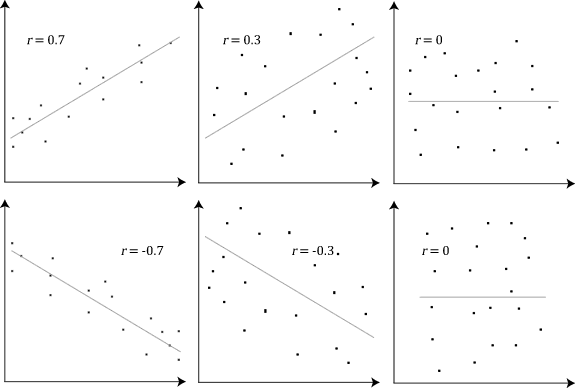
The stronger the association of the two variables, the closer the Pearson correlation coefficient, r, will be to either +1 or -1 depending on whether the relationship is positive or negative, respectively. Achieving a value of +1 or -1 means that all your data points are included on the line of best fit – there are no data points that show any variation away from this line. Values for r between +1 and -1 (for example, r = 0.8 or -0.4) indicate that there is variation around the line of best fit. The closer the value of r to 0 the greater the variation around the line of best fit. Different relationships and their correlation coefficients are shown in the diagram below:

Different values for the Pearson Correlation Coefficient

Cognitive Dissonance and Ignaz Semmelweis


"When new information is inconsistent with our existing beliefs, we experience mental discomfort - which we resolve by rejecting the information, regardless of the evidence. Psychologists call this tendency confirmation bias, which can be explained by another well-established psychological concept, cognitive dissonance."

"Doctors in mid-nineteenth century Vienna, for example, refused to accept strong evidence presented by one of their colleagues that washing hands before delivering babies would reduce maternal deaths from what was called 'childbed fever'. Instead, they got rid of the colleague, Ignaz Semmelweis."

Natalie Wexler, The Knowlegde Gap p75.


Tuesday, August 20, 2019

Cognitive Load Theory and its Application in the Classroom

Impact: Journal of the Chartered College of Teaching
The theory identifies three different forms of cognitive load: 
  • Intrinsic cognitive load: the inherent difficulty of the material itself, which can be influenced by prior knowledge of the topic 
  • Extraneous cognitive load: the load generated by the way the material is presented and which does not aid learning  
  • Germane cognitive load: the elements that aid information processing and contribute to the development of ‘schemas’.

Sunday, October 21, 2018

CastaƱeda and Selwyn - More than tools?

More than tools? Critical perspectives and alternative visions of technology in higher education
International Journal of Educational Technology in Higher Education
Edited by: Linda CastaƱeda and Neil Selwyn
Collection first published: 1 March 2018

1) We need to talk about learning.
2) We need to talk about pedagogy.
3) We  need to acknowledge the human aspects of digital technology use in education.
4) Digital technologies and the (hyper) individualisation of digital education.
5) Digital technologies and the commercialization of higher education.
6) Digital technologies and the neoliberalisation of higher education.
7) The need for the constructive criticism of digital technologies and higher education.

Everett Rogers - Diffusion of innovations

Theory to explain how, why and at what rate new ideas and technology spread.

Book first published in 1962.  Fifth edition published in 2003.

Four main elements influence the spread of a new idea:
  • The innovation itself
  • Communication channels
  • Time
  • Social system
When widely adopted, there is a point when an innovation reachs a critical mass.

Diffusion of innovation relies on human capital.  Adopters can be divided into innovators, early adopters, early majority, late majority, and laggards.


Thursday, December 1, 2016

What everyone should know about SLA

Bill Van Patten

1.  What's in your head
2.  Practice doesn't make perfect
3.  Communication
4.  Don't automatically blame the first language.
5. 

Communication = the expression, interpretation and negotiation of meaning in a given context.

Classrooms are fixed contexts for communication:
  • The setting is always the same.
  • Participants are always the same. 

Learners create an abstract mental representation, similar to the way in which L1 learners do.
This representation bears little to no resemblance to what is traditionally practised.
This representation builds up over time due to consistent and constant exposure to input data.  Practice, as traditionally conceived, does little to foster the development of representation.