Motive


This blog was set up as a personal project to record my study notes online. The large majority of the writings are those of the authors mentioned in the posts.

Saturday, August 31, 2019

Lesson Planning: Evaluating Learning and Reflecting on Teaching

Students’ tend to compartmentalise their reflections around stimuli emergent from critical incidents or problems that occur within lessons rather than reflecting the positive aspects of the lesson i.e. learning gains by pupils or what they have learned about their own practice.

Students often hold a range of personal epistemologies, which manifest the beliefs and attitudes they hold towards what constitutes knowledge.  This impacts upon the range and types of evidence they draw upon and what they perceive to be important within the lesson.

Gibbs (1988) Model of Reflection

Built from Kolb's experiential reflective cycle, it proposes that theory and practice enrich each other in a never-ending cycle.


Friday, August 30, 2019

English as an Additional Language (EAL)

This video was one of the resources on a task developing our thinking regarding inclusion.


BIC = Basic interpersonal communciation.  This includes organisational language such as commands and use of the imperative or simple questions.  It also includes insructions.

CALP = Cognitive academic language proficiency. Using language that involves reflection, evaluation and analysis. High ordeer thinking skills.
Second language aquisition - essential information

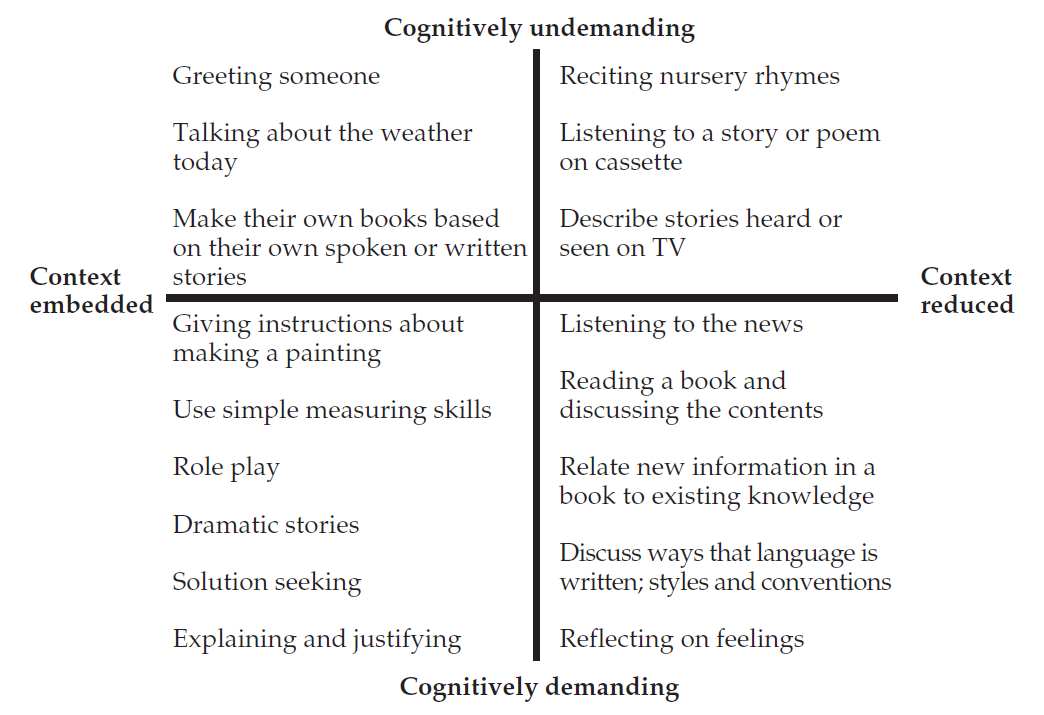
"Sensitivity to the need for context support and the cognitive demands of a classroom are important if an individual is to maximise learning in the curriculum"
Baker (2001:180)

Cummins' iceberg comparison. Above the surface are language skills such as comprehension and speaking. Underneath the surface are the skills of analysis and synthesis. Above the surface are the language skills of pronunciation, vocabulary and grammar. Below the surface are the deeper, subtle language skills of meanings and creative composition.


Context embedded communication (Good degree of support in communication, particularly via body language.)

Context reduced communication (Very few cues to the meaning that is being transmitted. The words of the sentence exist almost alone in conveying the meaning.)


Colin Baker (2001:176)


Regarding inclusion and how we percieve the world and people in it, I found this section really interesting:

"We make sense of our world by continual classification. People are constantly compared and contrasted. Yet the simplification of categorization often hides the complexity of reality. Sorting often simplifies unsympathetically. Individual differences are reduced to similarities. Yet over-complexity can be unwelcome and confusing. Complications can confound those needing order and pattern. The measurement of bilinguals attempts to locate similarities, order and pattern."
Baker (2001:18)

KEY POINTS FROM Chapter 8

• Two languages acting like a balance in the thinking quarters of a bilingual is incorrect. Instead the Common Underlying Proficiency model suggests that languages operate from the same central operating system.

• The Thresholds Theory suggests that bilinguals who have age-appropriate competence in both languages share cognitive advantages over monolinguals.

• There is a distinction between Basic Interpersonal Communicative Skills (BICS) that concern everyday, straightforward communication skills that are helped by contextual supports, and Cognitive/Academic Language Proficiency (CALP). CALP is the level of language required to understand academically demanding subject matter in a classroom. Such language is often abstract, without contextual supports such as gestures and the viewing of objects.

• On average, it takes about two years for a new immigrant to acquire Basic Interpersonal Communicative Skills in a second language, but five to eight years to achieve Cognitive/Academic Language Proficiency in that second language.

Colin Baker (2001) Foundations of Bilingual Education and Bilingualism, Multilingual Matters. 

Teach like a Champion - Doug Lemov

Technique 32: SLANT


OR:
Sit up straight, Listen, Ask and Answer questions, Nod you head, Track the speaker.

I might go with 'Nod your head' with younger learners and 'Note key info' with older students.

Tuesday, August 27, 2019

Approaches

There are many approaches which can be taken by teachers in the delivery of their lessons.  Some of the terms which are used to describe these ways of teaching are:

Inquiry-based Learning / Inquiry Model

aka: guided inquiry, open-ended inquiry, inductive thinking, creative thinking, discovery learning, the scientific method.

Dewey (1933): Inquiry is "active, persistent, and careful consideration of any belief or supposed form of knowledge in the light of the grounds that support it and the further consideration to which it tends."
→ reason, evidence, inference, and generalization.

The National Science Education Standards and Benchmarks for Scientific Literacy
→ observing, measuring, predicting, inferring, using numbers, using space-time relationships, defining operationally, formulating hypotheses, interpreting data, controlling variables, experimenting, and communicating.

In the context of learning, students engage in inquiry when faced with a "fork-road situation" → a perplexing problem that causes some discomfort → the essence of science inquiry activities.


Scientific literacy = the accumulated knowledge, skills, habits of mind of the scientific community.

Anderson, Holland, and Palinscar "from a sociocultural perspective, acquiring functional scientific literacy is not simply a matter of mastering and using a canon. It requires appropriate scientific discourse - learning to use language, think and act in ways that identify one as a member of a community of scientifically literate people and enable one to participate fully in the activities of the community."
→ teacher's role is to create a community of practice within the science classroom, engage learners in collaboration and problem solving activities, and to select problems and activities that interest students.

Four Models:
  • inductive inquiry
  • deductive inquiry
  • discovery learning (collaborative inquiry)
  • project-based inquiry

Inductive Inquiry

J Richard Suchman: 
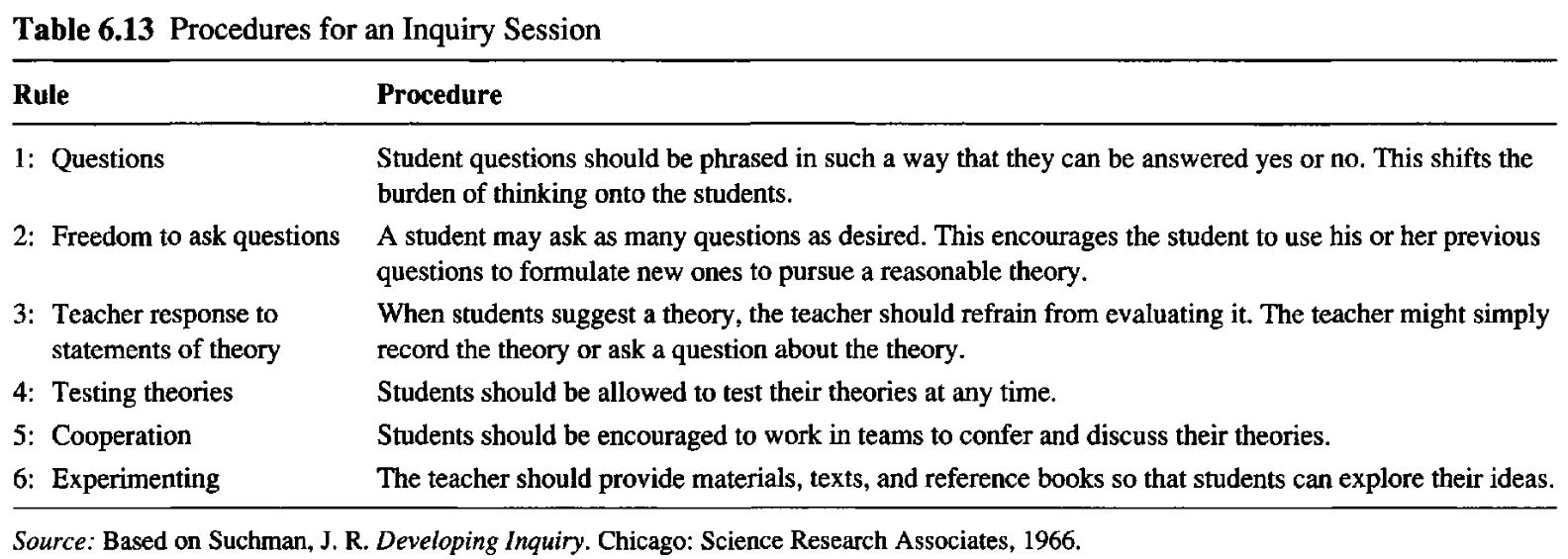
Inquiry is the active pursuit of meaning involving thought processes that change experience to bits of knowledge. When we see a strange object, for example, we may be puzzled about what it is, what it is made of, what it is used for, how it came into being, and so forth. To find answers to questions such as these we might examine the object closely, subject it to certain tests, compare it with other, more familiar objects, or ask people about it, and for a time our searching would be aimed at finding out whether any of these theories made sense. Or we might simply cast about for information that would suggest new theories for us to test. All these activities—observing, theorizing, experimenting, theory testing—are part of inquiry. The purpose of the activity is to gather enough information to put together theories that will make new experiences less strange and more meaningful.
Problem-focus events e.g. demonstrations or films. The demonstration is designed to present a discrepancy or a problem (NOT illustrate concepts or principles). Inquiry demonstrations are referred to as discrepant events.


The Art of Teaching Science pp 237

Didactic

Didactic method provides students with the required theoretical knowledge. It is an effective method used to teach students who are unable to organize their work and depend on the teachers for instructions. It is also used to teach basic skills of reading and writing. The teacher or the literate is the source of knowledge and the knowledge is transmitted to the students through didactic method.


Functions of didactic method
· cognitive function: to understand and learn basic concepts;
· formative-educative function: to develop skills, behaviour, abilities, etc.
· instrumental function: to achieve educational objectives;
· normative function: helps to achieve productive learning, attain required results, etc.

Method of teaching
In didactic method of teaching, the teacher gives instructions to the students and the students are mostly passive listeners. It is a teacher-centred method of teaching and is content oriented. The content or knowledge of the teacher is not questioned. 

The process of teaching involves the teacher who gives instructions, commands, delivers content, and provides necessary information. The pupil activity involves listening and memorization of the content. In the modern education system, lecture method which is one of the most commonly used methods is a form of didactic teaching. 

Direct teaching

Direct instruction (DI) is a general term for the explicit teaching of a skill-set using lectures or demonstrations of the material to students. A particular subset of direct instruction, denoted by capitalization as Direct Instruction, refers to a specific example of the approach developed by Siegfried Engelmann and Wesley C. Becker. DI teaches by explicit instruction, in contrast to exploratory models such as inquiry-based learning. DI includes tutorials, participatory laboratory classes, discussion, recitation, seminars, workshops, observation, active learning, practica, or internships.

DI relies on a systematic curriculum design, delivered by implementation of a prescribed behavioral script. On the premise that all students can learn and all teachers successfully teach if given effective training in specific techniques, teachers may be evaluated based on measurable student learning.

In some special education programs, direct instruction is used in resource rooms, when teachers assist with homework completion and academic remediation.

https://en.wikipedia.org/wiki/Direct_instruction 


Direct instruction is the use of straightforward, explicit teaching techniques, usually to teach a specific skill. It is a teacher-directed method, meaning that the teacher stands in front of a classroom and presents the information.

Experiential

Experiential learning is the process of learning through experience, and is more specifically defined as "learning through reflection on doing". Hands-on learning can be a form of experiential learning but does not necessarily involve students reflecting on their product.

Whole class

Whole group instruction is direct instruction using traditional textbooks or supplemental materials with minimal differentiation in either content or assessment. It is sometimes referred to as whole class instruction. It is typically provided through teacher-led direct instruction.

Teacher-centred (or teacher-led)


Pupil-centred


Resource-based 

Dewey (1933) How We Think: A Restatement of the Relation of Reflective Thinking to the Education Process

The Importance of Assessment

Effective testing enhances a teacher's instructional effectiveness.
(Popham, 2018:1)

Educational assessment is a formal attempt to determine students’ status with
respect to educational variables of interest. (Popham, 2018:10)

 Purpose of testing:
- to provide feedback about learner progress;
- to provide pupils with educative feedback;
- to motivate learners;
- to provide a record of progress;
- to provide a statement of current attainment;
- to assess learners' readiness for future learning;
- to provide evidence of teacher and school effectiveness.
(Kyriacou, 2007:105-106)

Traditional Reasons That Teachers Assess Students:
  • To determine students’ current status
  • To monitor students’ progress
  • To assign grades to students
  • To determine instructional effectiveness
 (Popham, 2018:17)


 High-stake tests have an impact on classroom instructional practice.


Today’s Reasons for Teachers to Know about Assessment:
  •  Test results determine public perceptions of educational effectiveness.
  • Students’ assessment performances are increasingly being included as part of the teacher evaluation process.
  • As clarifiers of instructional intentions, assessment devices can improve instructional quality.
 (Popham, 2018:17)

A wide variety of assessment instruments is important.

How to create classroom assessment approaches to measure students’ achievement (the knowledge and/or skills students acquire) and affect (the educationally pertinent attitudes, interests, and values influenced by school).

How to judge the quality of the assessment devices created is important.


References
Kyriacou, C (2007) Essential Teaching Skills.
Popham, W. James (2018) Classroom Assessment.

Saturday, August 24, 2019

The Classroom Dynamic as a Complex Adaptive System

Taken from chapter 6 of Mental Health and Well-Being in the Learning and Teaching Environment (2016).

Teacher identity = complex multifaceted construct.
Affected by temporal and transient events which fluctuate over time under the influence of a variety of factors which are internal (emotions, moods, attitude) and external (job & life experiences).

Also influenced by teachers' collective conceptualisations of professionalism, as well as individual views of themselves.


Teacher identity is both a product and process > CAS

Not only pedagogical content knowlegde (PCK, Lee Shulman), subject knowledge or classroom management & emotional aspects but also...

"interaction between the personal experiences of teachers and the social, cultural and institutional environment in which they function on a daily basis." (Sleeger and Klechtermans, 1999)

Collegiality - key role, influences culture within educational establishments and functions as either support or stressor.

Teaching demands a significant personal investment and commitment + there is undoudtedly a significant relationship between  the personal and professional self.

Geert Lelchtermans (1993). Professional self evolves over time and consists of 5 interrelated components:
  • Self-image
  • Self-esteem
  • Job motivation
  • Task perception
  • Future perspective

AGENCY

Teacher agency = sense of empowerment to be able to move ideas forward, to reach or to transform their professional context.  Realisation of one's identity; a heightened awareness of one's identity which may lead to a stronger sense of agency.

Lesson planning = systematic development of instructional requirements, arrangement, conditions, resources and activities, as well as the assessment and evaluation of teaching and learning.

Lesson planning requires analysis of learning needs of students and the development of a delivery structure to meet those needs.

Schon (1983) lesson planning is the proactive decision-making that takes place before instruction


Curriculum for Excellence


Sciences - Experiences and outcomes

The sciences framework provides a range of different contexts for learning which draw on important aspects of everyday life and work.

Learning in the sciences will enable me to:

develop curiosity and understanding of the environment and my place in the living, material and physical world;
• demonstrate a secure knowledge and understanding of the big ideas and concepts of the sciences;
develop skills for learning, life and work;
• develop the skills of scientific inquiry and investigation using practical techniques;
• develop skills in the accurate use of scientific language, formulae and equations;
• apply safety measures and take necessary actions to control risk and hazards;
• recognise the impact the sciences make on my life, the lives of others, the environment and on society;
• recognise the role of creativity and inventiveness in the development of the sciences;
develop an understanding of the Earth’s resources and the need for responsible use of them;
express opinions and make decisions on social, moral, ethical, economic and environmental issues based upon sound understanding;
• develop as a scientifically-literate citizen with a lifelong interest in the sciences;
establish the foundation for more advanced learning and future careers in the sciences and the technologies.